The potential role of airborne and floating wind in the North Sea region
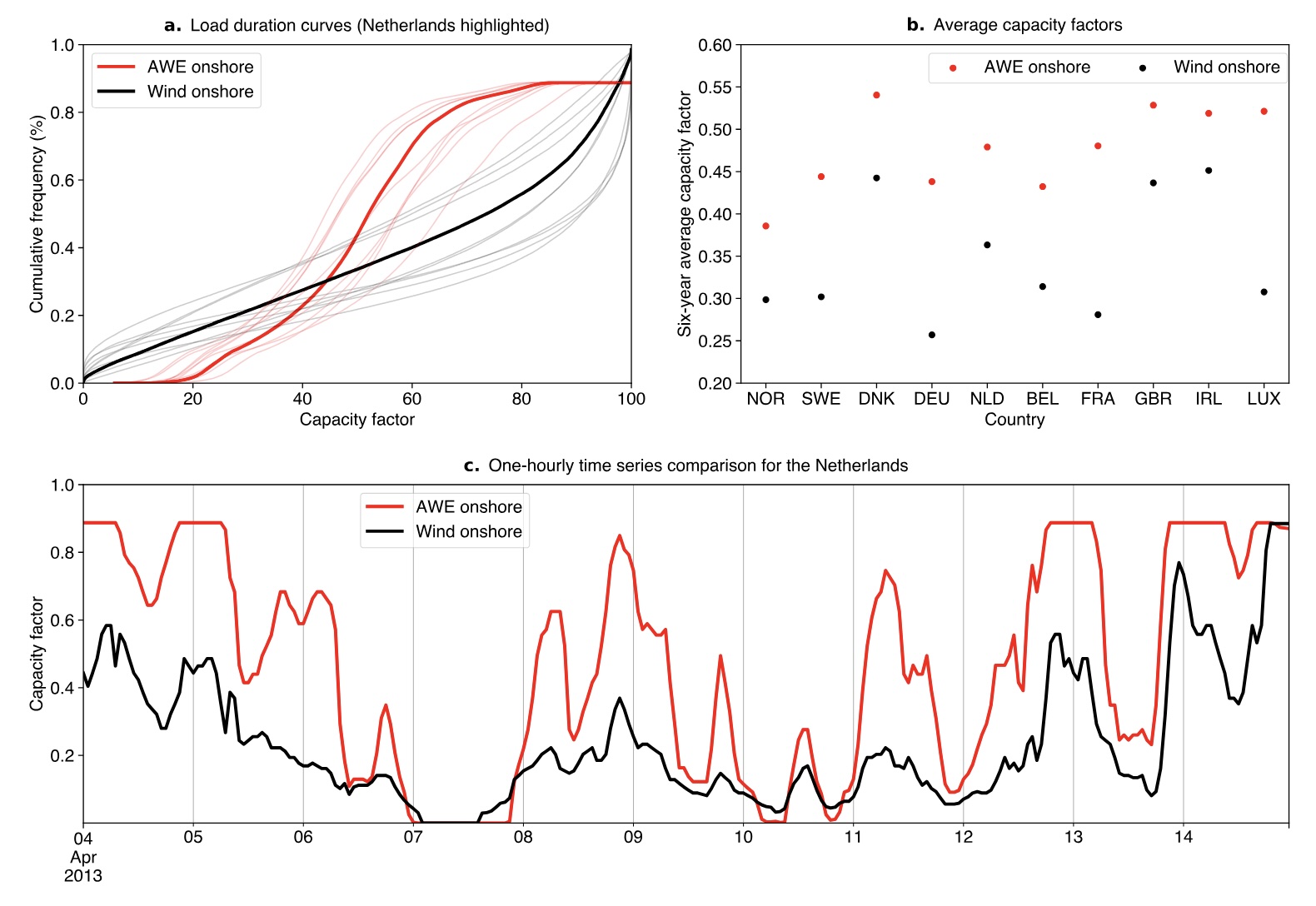
Load duration curves of onshore AWE compared to onshore wind turbines (thick lines representing the Netherlands, lighter lines all the other countries in the model) (a), average national capacity factors over six years (b), and ten days of generation of onshore AWE and onshore wind turbines in the Netherlands, arbitrarily selected among days in which the profile distinctiveness is particularly marked (c)
Airborne wind energy (AWE) systems and floating offshore turbines could unlock wind resources that conventional turbines cannot reach. However, their techno-economic potential has so far only been studied at small scale. We integrate wind resource assessment and future cost projections for both technologies into a sector-coupled, hourly-resolved energy system model of ten North Sea countries. Onshore AWE consistently outperforms conventional onshore wind thanks to stronger and distinctively-patterned winds at 250–600 m altitude, reducing total system costs by 3–16% depending on achievable power density per ground area, which emerges as the main limiting factor, more so than device cost. Offshore, AWE behaves much like its conventional rivals and competes primarily on cost. Floating turbines have higher capacity factors because they can be farther offshore, keeping them competitive even when slightly more expensive than fixed-bottom turbines. AWE in particular could play a significant role in a climate-neutral European energy supply, potentially as early as the 2030s. → Vos, Lombardi, Joshi, Schmehl and Pfenninger (2024), Environmental Research: Energy.