Land conservation and large-scale renewable energy are simultaneously possible in Brazil
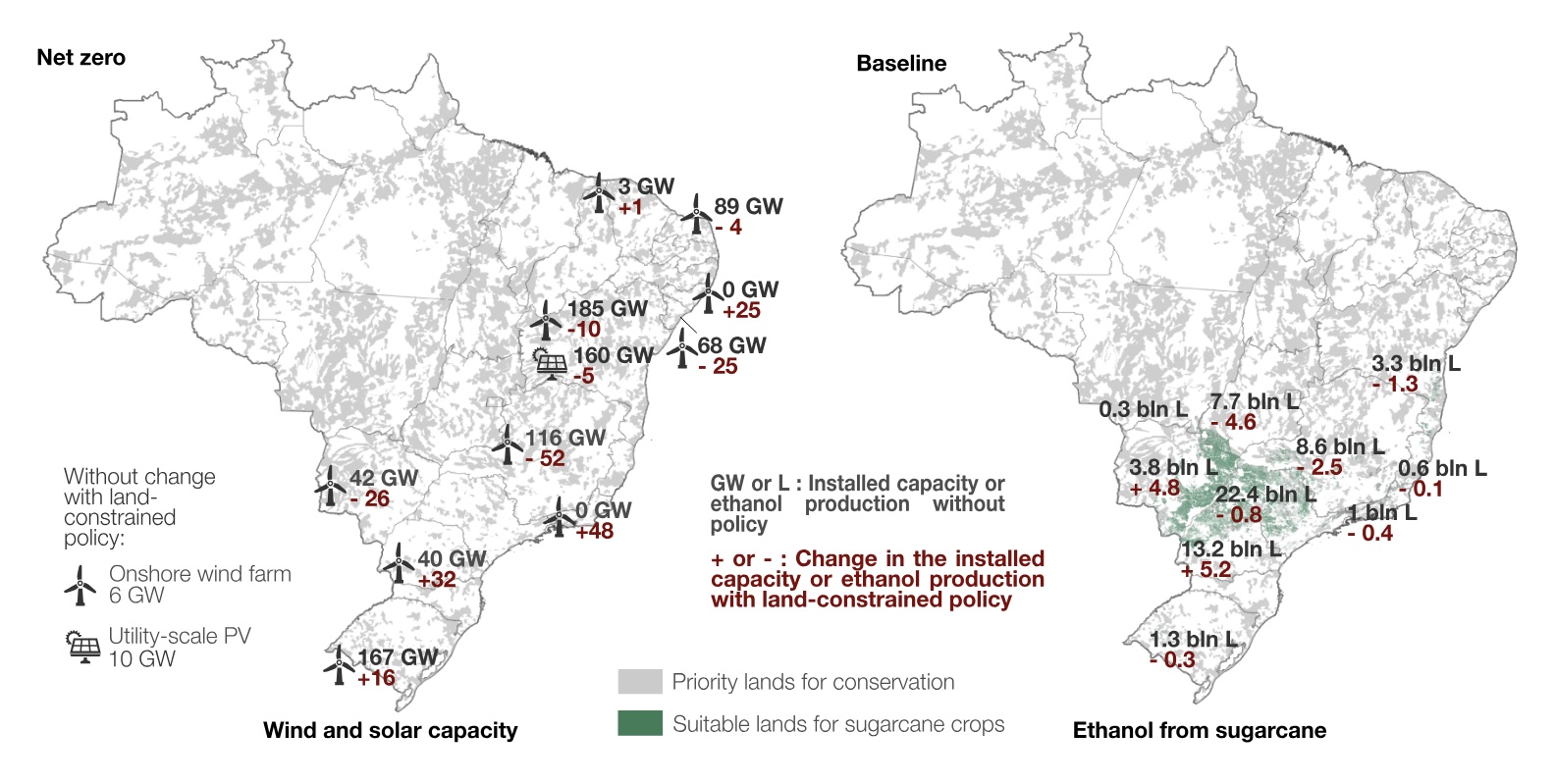
Spatial shifts in renewable generation and biofuel production under land-constrained policies: Shifts in the installed capacity of wind and solar farms (left) and in ethanol production (right) when land-constrained policy is considered. The first map represents the changes in the net-zero scenario, and the second one indicates the changes in the baseline scenario.
Brazil’s push towards net-zero emissions relies heavily on land-hungry renewables: biofuels, solar and wind all compete for space with globally vital ecosystems. Using Brazil-Calliope, a high-resolution, spatially explicit energy system model, we show that a cost-effective, large-scale renewable energy system is possible while fully protecting priority conservation areas. Relocating generation away from these areas raises system costs by only 0.1–4% depending on the scenario, and freeing them up for restoration could enable an additional 770 million tons of annual CO2 sequestration. The vast majority of land conversion involved in this comes from pasture and soy plantations rather than natural vegetation, and degraded pasture lands in particular are prime candidates for re-forestation. Overall, we find that smart spatial planning can reconcile Brazil’s renewable energy transition with its stewardship of biodiversity. → Borba, de Sousa and Pfenninger (2025), One Earth.