Spotlight

21 Nov 2025 #spotlight

Land conservation and large-scale renewable energy are simultaneously possible in Brazil

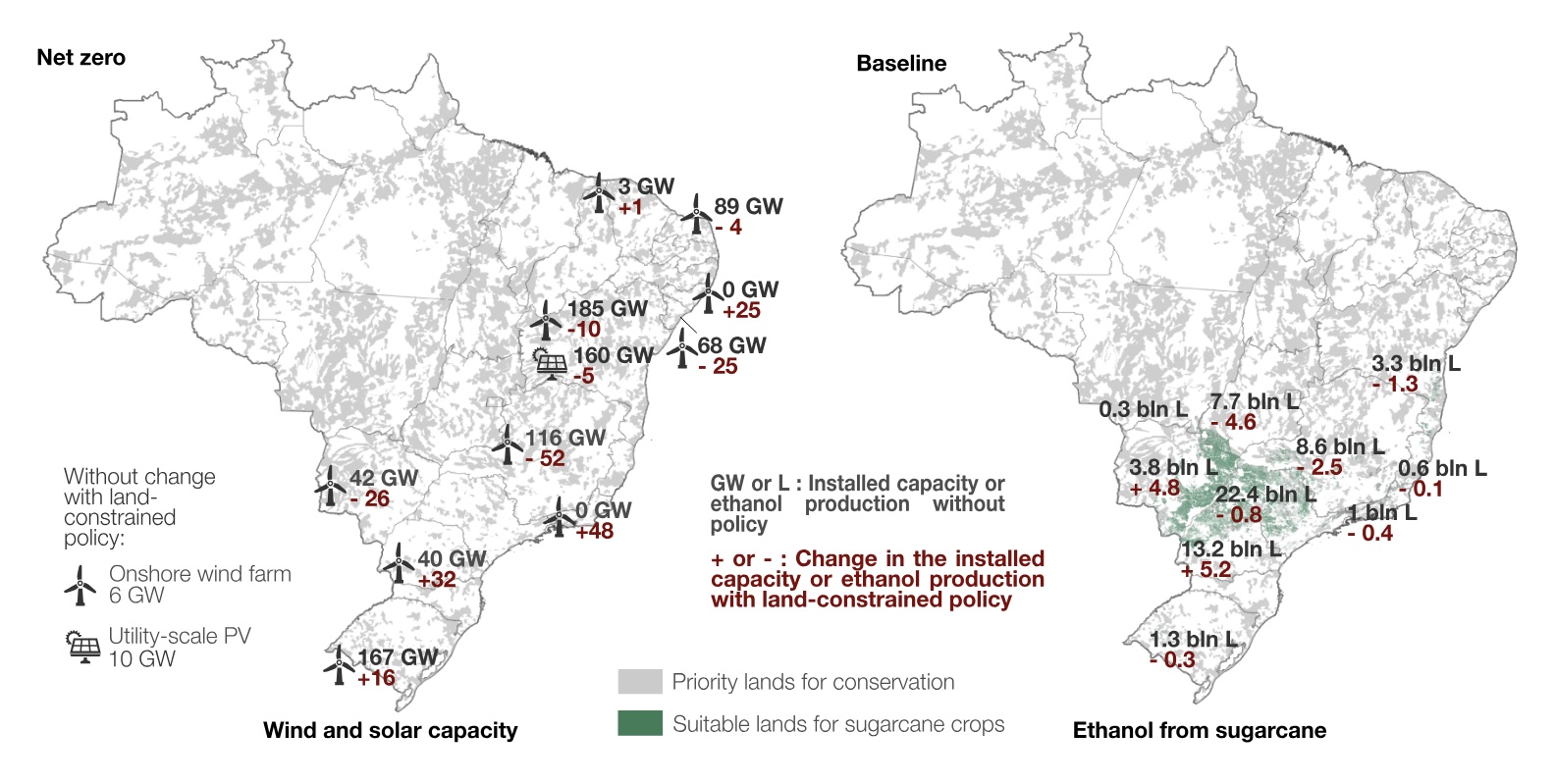
Spatial shifts in renewable generation and biofuel production under land-constrained policies: Shifts in the installed capacity of wind and solar farms (left) and in ethanol production (right) when land-constrained policy is considered. The first map represents the changes in the net-zero scenario, and the second one indicates the changes in the baseline scenario.
Spatial shifts in renewable generation and biofuel production under land-constrained policies: Shifts in the installed capacity of wind and solar farms (left) and in ethanol production (right) when land-constrained policy is considered. The first map represents the changes in the net-zero scenario, and the second one indicates the changes in the baseline scenario.

Brazil’s push towards net-zero emissions relies heavily on land-hungry renewables: biofuels, solar and wind all compete for space with globally vital ecosystems. Using Brazil-Calliope, a high-resolution, spatially explicit energy system model, we show that a cost-effective, large-scale renewable energy system is possible while fully protecting priority conservation areas. Relocating generation away from these areas raises system costs by only 0.1–4% depending on the scenario, and freeing them up for restoration could enable an additional 770 million tons of annual CO2 sequestration. The vast majority of land conversion involved in this comes from pasture and soy plantations rather than natural vegetation, and degraded pasture lands in particular are prime candidates for re-forestation. Overall, we find that smart spatial planning can reconcile Brazil’s renewable energy transition with its stewardship of biodiversity. → Borba, de Sousa and Pfenninger (2025), One Earth.
1 Sep 2025 #spotlight

Rarely pure and never simple: how energy modellers think about truth and objectivity

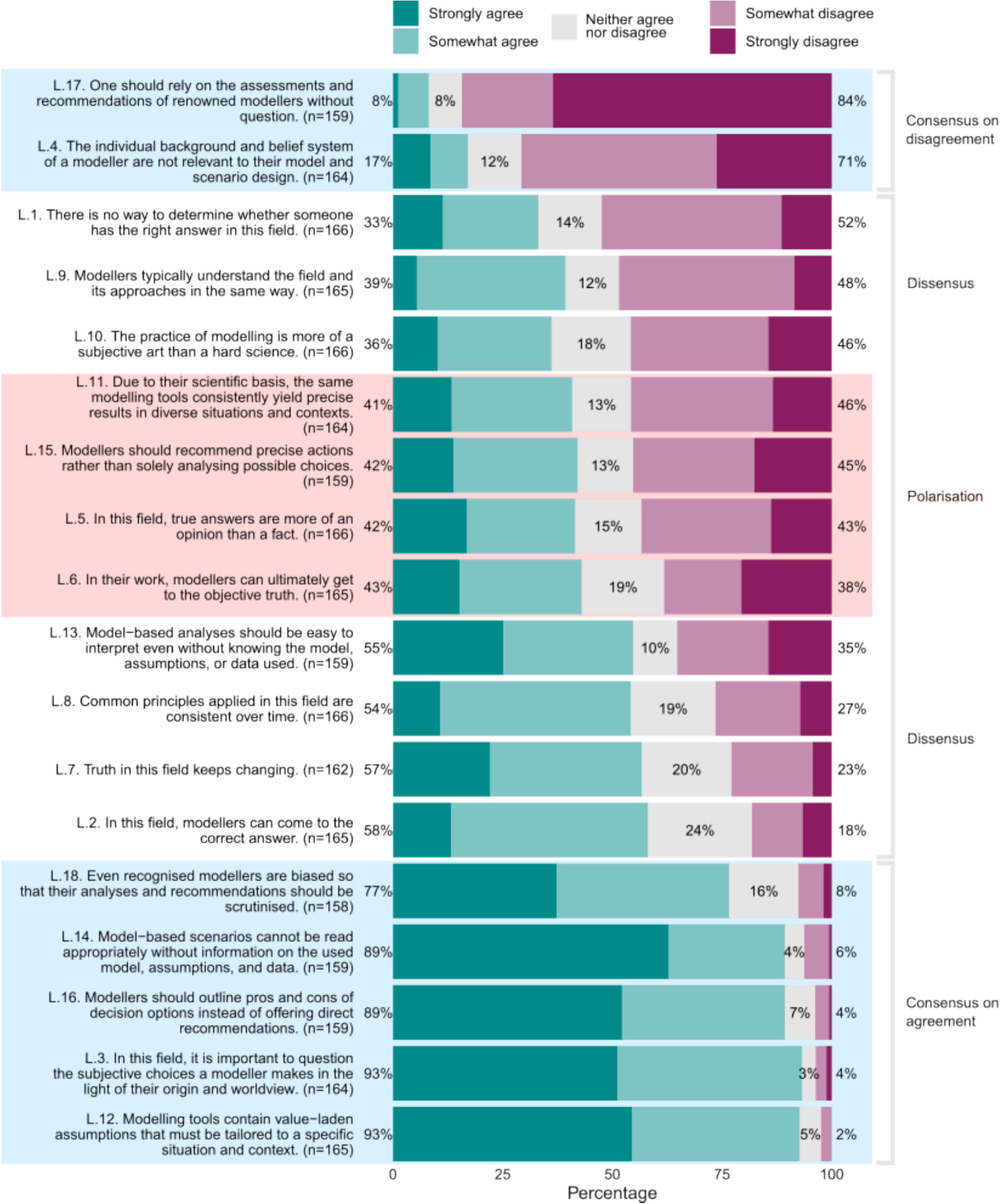
Survey participants’ ratings of the presented Likert items. Items reflect two broadly opposing epistemic orientations; consistent views would typically result in a mix of agreement and disagreement rather than uniformly high or low ratings.

Survey participants’ ratings of the presented Likert items. Items reflect two broadly opposing epistemic orientations; consistent views would typically result in a mix of agreement and disagreement rather than uniformly high or low ratings.

Model-based scenarios guide energy planning and climate policy, yet the beliefs modellers themselves hold about truth and objectivity in their work have received little empirical attention. In a survey of more than 160 experts across regions and disciplines, we find some areas of agreement, but also polarisation. Views cluster into two stylised profiles, the “Positivist Modeller”, who sees models as approximating an objective reality, and the “Postpositivist Modeller”, who views model results as contingent, value-laden constructs. Since epistemic beliefs shape how modellers present findings to decision-makers, making them explicit matters for the credibility of model-based policy advice. → Bock and Pfenninger-Lee (2025), Energy Research & Social Science.

3 May 2024 #spotlight

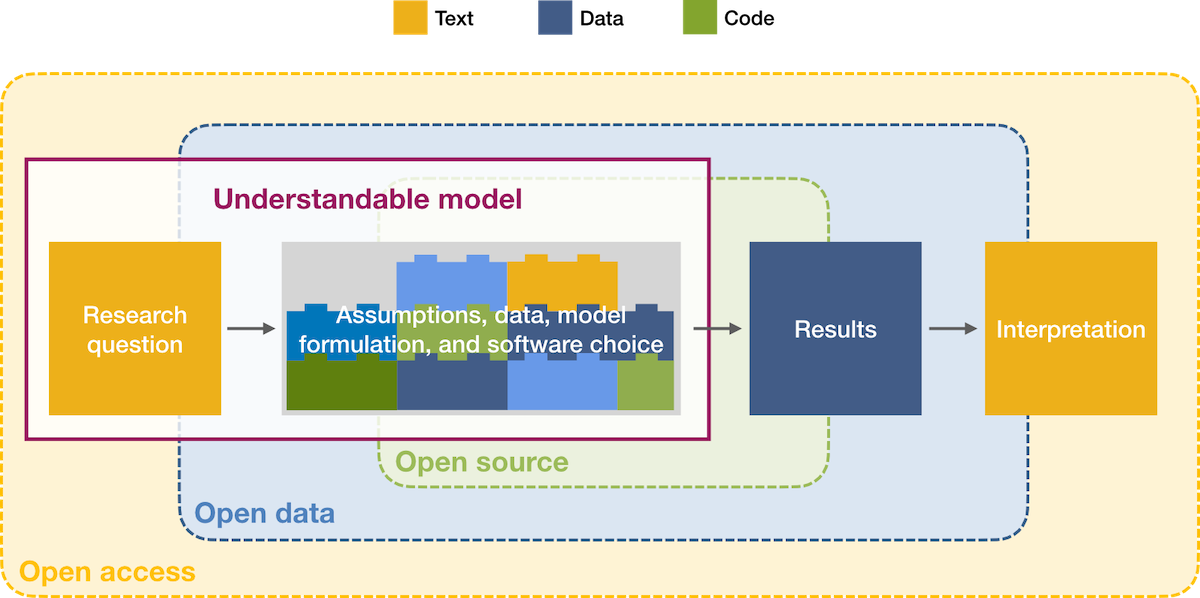
Understandable modelling with modular building blocks

Energy system models are assumption-based representations of complex systems, making validation impractical. Post-normal science suggests instead a focus on communicating values and uncertainties. Open energy modelling can support this by breaking models into manageable parts. Collaboration on these components (whether code or data) would simplify and accelerate model development, while improving accessibility and understandability for users. → Pfenninger (2024), Progress in Energy.

29 Apr 2024 #spotlight

The potential role of airborne and floating wind in the North Sea region

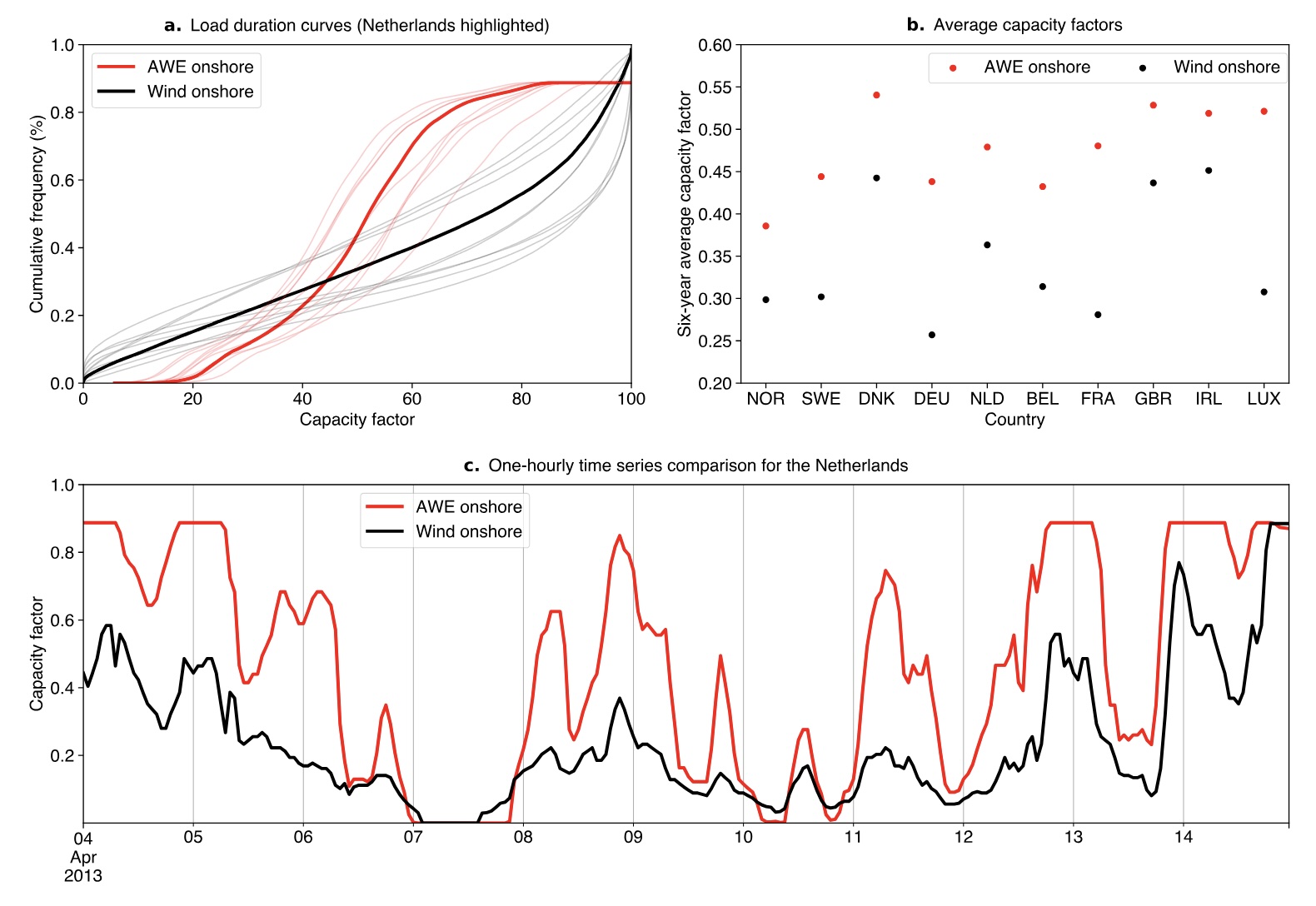
Load duration curves of onshore AWE compared to onshore wind turbines (thick lines representing the Netherlands, lighter lines all the other countries in the model) (a), average national capacity factors over six years (b), and ten days of generation of onshore AWE and onshore wind turbines in the Netherlands, arbitrarily selected among days in which the profile distinctiveness is particularly marked (c)

Load duration curves of onshore AWE compared to onshore wind turbines (thick lines representing the Netherlands, lighter lines all the other countries in the model) (a), average national capacity factors over six years (b), and ten days of generation of onshore AWE and onshore wind turbines in the Netherlands, arbitrarily selected among days in which the profile distinctiveness is particularly marked (c)

Airborne wind energy (AWE) systems and floating offshore turbines could unlock wind resources that conventional turbines cannot reach. However, their techno-economic potential has so far only been studied at small scale. We integrate wind resource assessment and future cost projections for both technologies into a sector-coupled, hourly-resolved energy system model of ten North Sea countries. Onshore AWE consistently outperforms conventional onshore wind thanks to stronger and distinctively-patterned winds at 250–600 m altitude, reducing total system costs by 3–16% depending on achievable power density per ground area, which emerges as the main limiting factor, more so than device cost. Offshore, AWE behaves much like its conventional rivals and competes primarily on cost. Floating turbines have higher capacity factors because they can be farther offshore, keeping them competitive even when slightly more expensive than fixed-bottom turbines. AWE in particular could play a significant role in a climate-neutral European energy supply, potentially as early as the 2030s. → Vos, Lombardi, Joshi, Schmehl and Pfenninger (2024), Environmental Research: Energy.

9 Jun 2022 #spotlight

Diversity of options to eliminate fossil fuels and reach carbon neutrality across the entire European energy system

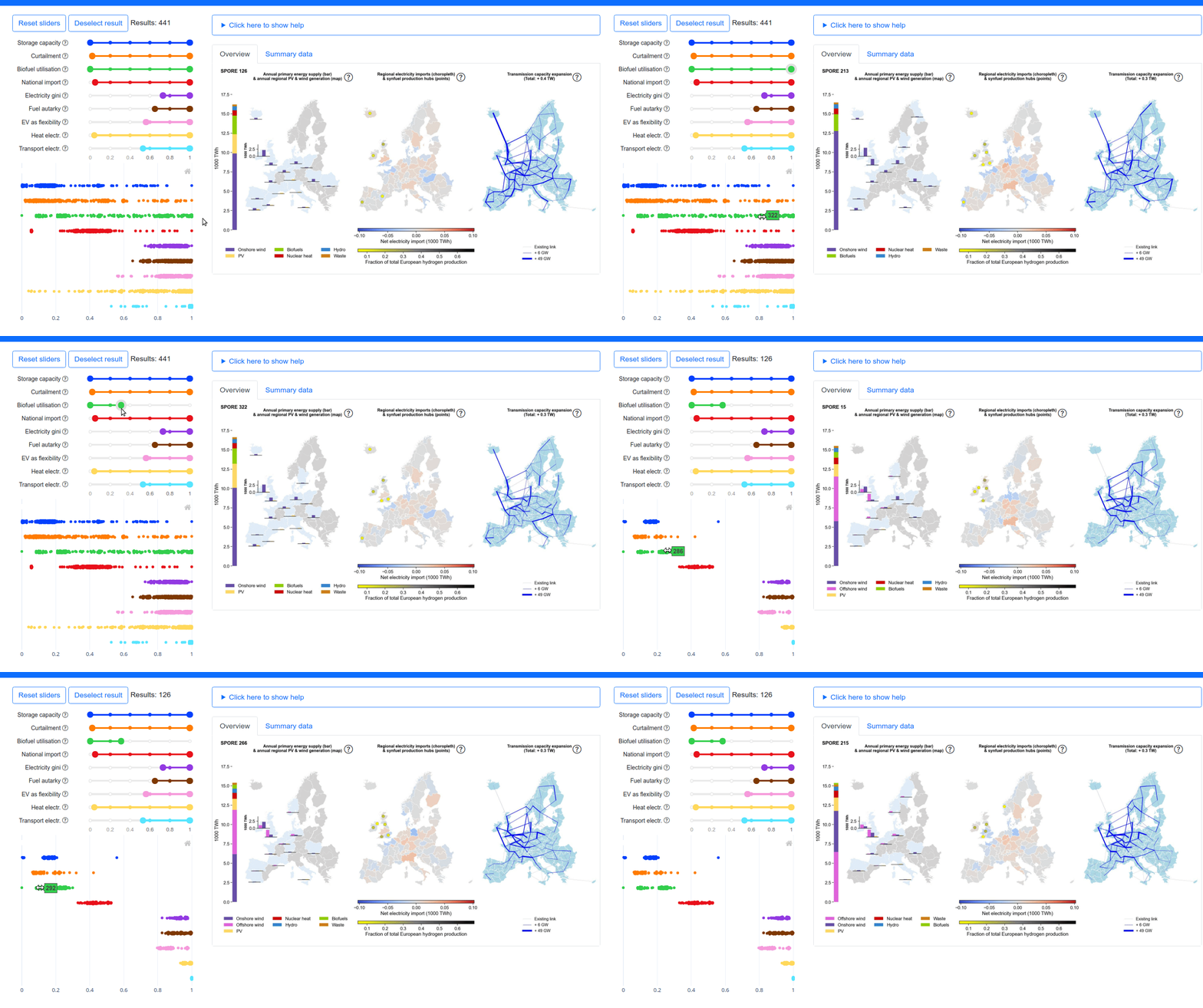
The interactive scenario explorer in action.

The interactive scenario explorer in action.

We show a diversity of untold options to meet all energy demand based on renewable energy, with a complete phase-out of oil and gas imports. The results can be viewed in an interactive scenario explorer. With a marginal increase above optimal cost, the reliance of an energy self-sufficient Europe on specific solutions, like biofuels, battery storage, transmission expansion, or heat electrification, can vary from not being used at all to being key to system stability. → Pickering, Lombardi and Pfenninger (2022), Joule.